Research Data Management
Proper handling of research data is one of the most important prerequisites for good scientific work. A professional approach to managing research data helps ensure compliance with the principles of Good Scientific Practice.
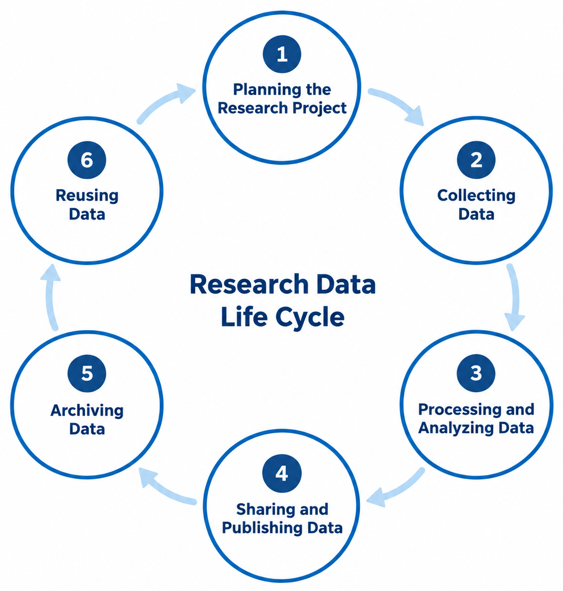
This requires working systematically through the stages of the data life cycle, supported by a data management plan. The research data life cycle is a key tool for organizing and planning the handling of data throughout a research project: it describes how research data passes through a series of stages, each with its own specific tasks.
Different versions of the model exist, with varying levels of detail and slightly different terminology, but the underlying idea remains the same; the scope of the tasks in each stage varies depending on the discipline and the nature of the research project. The model used here (adapted from forschungsdaten.info) divides the life cycle into six stages — planning, collecting, processing and analyzing, sharing and publishing, archiving, and reusing.
The Data Life Cycle
The sections below explain each stage together with the services the Computer Center and University Library offers to support it.
1. Planning the Research Project
Good data management begins before the first measurement is taken. At this stage you decide how data will be created, documented, stored and, later, shared. You record those decisions in a data management plan (DMP). Many funding agencies now expect such a plan as part of the proposal.
What happens in this stage:
- Design the study with data handling in mind
- Locate data that already exists and can be reused
- Plan data management, including file formats and storage locations
- Plan and prepare consent procedures for data sharing
Our services:
- RDMO: Our institutional tool for writing and maintaining data management plans, with templates for common funding agencies requirements: https://rdmo.fdm.uni-greifswald.de/
- Guidance on data management plans, including what a DMP should cover and how we can support you in drafting the Daten-Management-Plan.
2. Collecting Data
During data collection, data is generated through experiments, observations, measurements or simulations. Consistent file naming, structured storage and reliable backups from day one save considerable effort later in the project.
What happens in this stage:
- Carry out experiments, observations, measurements, simulations, etc.
- Obtain permission for data use where necessary.
Our services:
- Technical support from the Computer Center for questions arising during data collection. For example on storage locations, access, backups and suitable file formats.
3. Processing and Analyzing Data
This is usually the longest phase of a project. Raw data is prepared, checked and analyzed, and the steps taken are documented so that the results remain traceable and reproducible.
What happens in this stage:
- Enter, digitize, transcribe or translate data
- Secure and manage data
- Check, validate and clean data
- Anonymize data where necessary
- Describe the data
- Interpret the data
- Output research results
- Prepare for data preservation
Our services:
Technical consultation while processing and analyzing your data.
Hosting of the applications you need for processing and analysis on the AppHub application webserver https://apphub.wolke.uni-greifswald.de/ or on the High Performance Computing Cluster Brain : https://rz.uni-greifswald.de/dienste/allgemein/sonstiges/high-performance-computing/
4. Sharing and Publishing Data
Sharing data within the project team, with cooperation partners or with the wider research community requires clarity about rights and access. Published data becomes quotable and visible alongside your text publications. Support on specific publication questions and legal support can be obtained through the University Library.
What happens in this stage:
- Establish copyright and usage rights
- Control access to the data
- Share the data
- Publicize the data
Our services:
- Nextcloud for storing and exchanging smaller datasets during the project, for example within a working group or with external partners: https://nextcloud.uni-greifswald.de/
- CKAN, our research data repository, for publishing datasets. Published records with an archive status receive a persistent identifier (PID) so that your data can be cited reliably: https://ckan.fdm.uni-greifswald.de/
5. Archiving Data
Good scientific practice requires research data to be kept for at least ten years. Archiving means storing the data in sustainable formats, on suitable media, and with enough metadata that it can still be understood years from now.
What happens in this stage:
- Migrate data to suitable formats
- Migrate data to suitable storage media
- Create backups and secure data
- Create and document metadata
- Archive the data
Our services:
CKAN can also be used for long-term archiving of your datasets, together with their descriptive metadata: https://ckan.fdm.uni-greifswald.de/
6. Reusing Data
The life cycle closes where it began: well-documented data becomes the starting point for new research questions, for teaching, or for verifying earlier findings — by your own group or by others.
What happens in this stage:
- Review previous results
- Conduct further research using existing data
- Review prior research
- Draw lessons and support learning
Where to find support (external to the Rechenzentrum):
The University Library (Universitätsbibliothek) advises on finding and reusing existing research data, including searching repositories and questions of licensing and citation.
Further Relevant Resources:
- Research data management services and support provided by the University Computer Center.
- Research data management services and support provided by the University Library.